Lord Vitthal
"The God who stands waiting for you — with open arms, on the banks of the Chandrabhaga."
Who is Lord Vitthal?
Lord Vitthal, lovingly known as Mauli, is the presiding deity of Pandharpur and one of the most cherished forms of Lord Krishna in Maharashtra’s Bhakti tradition. For countless devotees, he is not a distant God, but a compassionate presence who listens, waits, and welcomes every heart with patience and love. His devotion lives through the Wari, Abhangas, Bhajans, Kirtans & the teachings of great saints such as Dnyaneshwar, Tukaram & Namdev. Vitthal stands at the centre of Maharashtra’s devotional movement because He makes Bhakti simple, personal, equal & deeply comforting.
Vitthal’s iconic form, standing on a small brick with hands resting on His waist in kati-hast mudra, carries a profound spiritual message. The brick recalls the devotion of Pundalik & teaches that sincere service, especially towards one’s parents and family, is itself a sacred prayer. His steady stance reflects patience, balance & the Lord’s loving wait for His devotees to return. Alongside him is Rukmini, worshipped as Rakhumai, whose presence completes the divine bond of love, dignity & devotion that makes Pandharpur a living home of faith.
"One who has no caste distinction, who has no pride of lineage, who bows to all living creatures — he alone is dear to Vitthal."
— Sant Tukaram, Abhang 14306 Teachings of Lord Vitthal
The core spiritual wisdom of Vitthal as expressed through Maharashtra's Bhakti saints
Vitthal teaches that sincere daily duty is one of the purest forms of worship. Serving parents, caring for family, working honestly, and living with kindness become sacred acts when done with devotion. In His path, work itself becomes worship.
Vitthal is the God of the people, welcoming every devotee without distinction. His teaching reminds us that the same Divine presence lives within all, beyond wealth, caste, gender, or status. To respect another heart is to honour Vitthal within them.
Vitthal shows us the healing power of remembering the Divine Name. The simple chant of “Vitthal, Vitthal” can calm the mind, soften worry, and bring inner silence. It is a path of peace available anytime, anywhere, to every devotee.
To Vitthal’s devotees, God is not a distant judge but a nurturing Mauli. His love is unconditional, forgiving, and deeply comforting. He waits with patience, welcoming every heart back with safety, belonging, and the quiet assurance that we are never alone.
Vitthal teaches us to see God in every living being. Feeding the hungry, helping those in pain, or caring for animals becomes service to Him. Through small acts of compassion, daily life becomes a path of devotion, empathy, and spiritual growth.
Vitthal’s steady posture teaches the art of living in the world without being overwhelmed by it. He reminds us to fulfil our duties with sincerity while keeping the heart connected to the Divine. This balance brings peace in success, failure, and everyday life.
7 Sacred Stories
The beloved tales of Lord Vitthal's grace, love, and divine play
Janabai was a 13th-century saint and a devoted maidservant in the household of Sant Namdev. Her life was a tapestry of hard work and devotion woven into the fabric of daily routine. Each day began before dawn, when the world still slumbered in darkness. Janabai would rise with the first light of the stars, ready to tackle her arduous tasks. The heavy stone grinder, known as a "jata," stood as a constant reminder of her laborious days, requiring immense effort to transform grains into flour.
Despite the backbreaking work, Janabai's soul resonated with joy. She often sang Abhangas—devotional songs dedicated to her beloved deity, Vithoba. These melodies filled her small kitchen, turning her labor into a sacred ritual. One particularly cold morning, as she stood before the daunting stone grinder, fatigue enveloped her like a heavy cloak. The weight of the stone felt unbearable, and she sank to her knees, tears streaming down her face. “Vithoba,” she cried out, “your daughter is tired. I cannot do this alone today.”
In that moment of desperation, the air shimmered with divine presence. Lord Vitthal, unable to bear the sight of her struggle, descended to the earth. He entered her humble kitchen and took His place beside her. His divine hands rested on the wooden handle of the grinder. Miraculously, with every turn, the grinding became effortless. After the work was done, He didn’t leave; He helped her clean the floor and fetch water from the river.
Moral: This story teaches us that God walks beside us in our daily tasks. He is not aloof or distant; rather, He is a compassionate friend, always ready to lend a hand when we call upon Him with love and sincerity.
Sena Nhavi, a barber renowned for his skills, was deeply devoted to Vithoba. Every morning began with prayers and chanting, allowing him to immerse himself in the presence of the divine, transcending the mundane.
One fateful morning, as he recited hymns, engrossed in his spiritual trance, a royal messenger burst into his modest shop. The local King demanded an immediate haircut, his impatience palpable. Sena's wife, observing her husband's deep focus, wrestled with her instinct not to disturb him while feeling the heat of the King's wrath looming near.
In a moment of divine intervention, Lord Vitthal, sensing the peril facing His devoted servant, decided to take matters into His own hands. He transformed into Sena’s likeness, clad Himself in the barber’s attire, and made His way to the palace. Standing before the monarch, Lord Vitthal began the haircut with unparalleled grace.
As the King caught sight of himself in a bowl of oil—meant as a mirror—he was bewildered. Instead of a barber, he saw a magnificent, four-armed form of Vishnu, radiating celestial light. A profound peace washed over him, banishing his anger. When the real Sena finally arrived to apologize for his delay, the King’s confusion deepened. "But you were just here," he exclaimed, “and your touch felt like a blessing from heaven.”
Moral: This story illustrates that when one surrenders wholeheartedly in devotion, God takes command of the situation, protecting His devotees' reputations and safety even when they are unaware.
Sant Chokhamela was a revered saint known for his unwavering faith, yet he faced countless hardships in his life. Due to societal norms of his time, he was prohibited from entering the inner sanctum of the temple. Living by the banks of the river Chandrabhaga, he spent his days yearning for a glimpse of the temple spire from afar.
One day, while he was laboring to construct a wall in a nearby village, tragedy struck—the wall crumbled, and Chokhamela, along with many other workers, was buried beneath the heavy stones. When Sant Namdev learned of this calamity, he rushed to the site, determined to find Chokhamela’s remains to honor him with a burial at the temple.
Amidst the chaos of bodies buried beneath the rubble, Namdev faced the daunting task of identifying Chokhamela. He carefully listened to the bones of the fallen workers when suddenly, from one set of bones, he heard a rhythmic chant: “Vitthal... Vitthal... Vitthal...” Even in death, Chokhamela’s bones were resonating with the name of the Lord.
Moved by this profound devotion, Namdev gently gathered the remains and brought them to Pandharpur. He buried Chokhamela at the temple's entrance, a testament to the unwavering love that transcends social barriers.
Moral: This story teaches us that true devotion reaches beyond physical existence; it penetrates the very essence of our being. It beautifully illustrates that God sees not our social standings but rather the sincere vibrations of our love and devotion.
Lord Vitthal held a special affection for Sant Janabai, often forgetting His divine status when He was with her. One night, after assisting Janabai with her chores, the Lord hurriedly departed, unintentionally leaving behind His precious jewel-studded necklace around her neck while taking her old, tattered blanket back to the temple.
The following morning, the temple priests were in shock to find Lord Vitthal donning the worn blanket, with the necklace missing. Their search led them to Janabai’s humble home, where she was accused of theft. Justice was swift, and she was sentenced to death. As she stood bound to the iron pillar at the gallows, Janabai did not plead for mercy. Instead, she looked skyward and sang, “Vithu, this is Your play. If You wish for me to leave, so be it!”
In this moment of despair, Janabai’s unwavering faith and devotion shone brightly, illustrating the depth of her love for the Lord. This story serves as a remarkable reminder that true devotion transcends even the most dire circumstances, revealing how divine love can be both transformative and redemptive.
Moral: The narrative teaches that true faith remains steadfast even in the face of adversity, showing how divine love can elevate our souls beyond societal judgment.
In the 16th century, King Krishnadevaraya of the Vijayanagara Empire was captivated by the beauty of the idol of Lord Vitthal. Overwhelmed by his admiration, he decided to take the revered idol from the beloved temple in Pandharpur back to his grand city of Hampi. This decision shattered the hearts of the people of Pandharpur, who couldn’t bear the thought of their cherished Lord being taken away.
Among these devoted people was Sant Bhanudas, the great-grandfather of the renowned Sant Eknath. Unable to accept the impending separation from the idol, he embarked on a courageous journey to Hampi, where he stealthily entered the palace temple one fateful night. There, he spoke earnestly to the Lord, imploring Him, “Please, come back to Pandharpur. You rightfully belong there!”
To his surprise, the Lord responded, “I was brought here by the King’s love, but my heart is still in Pandharpur. Take me back.” However, as fate would have it, the King discovered Bhanudas in the temple. Infuriated by what he perceived as an act of treachery, he ordered his soldiers to execute Bhanudas on a sharp iron stake.
Despite the grave situation, Bhanudas remained composed, chanting the name of the Lord as he was led to his dire fate. In a miraculous turn of events, the iron stake began to bloom with lush green leaves and vibrant flowers! Astonished, the King realized the error of his actions. Overcome with humility, he fell to his knees, begging for forgiveness. In a heartfelt gesture, he vowed to return the idol to Pandharpur, leading the celebrations with grandeur and devotion.
Moral: This powerful story teaches that God cannot be owned by the mighty or the wealthy; He belongs to those who love Him unconditionally. It reminds us that even when circumstances seem impossible—like an iron stake blossoming with life—faith can transform despair into divine celebration.
The Pandharpur Wari
The great pilgrimage to Vitthal — 700 years of walking devotion
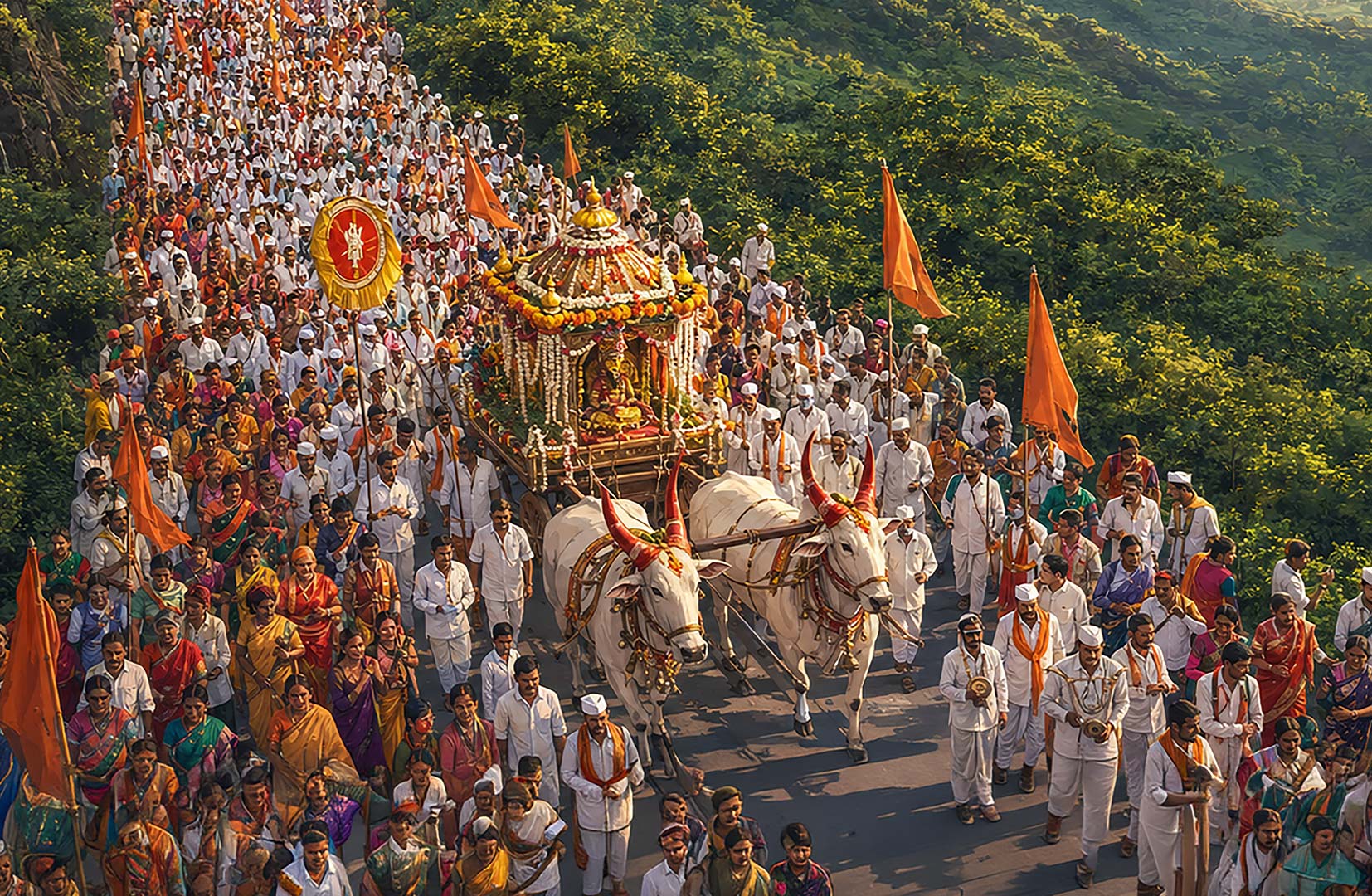
Pandharpur Wari 2026
Walk the sacred 250km from Alandi to Pandharpur with thousands of Warkaris. SwarSewa presents a special programme of music, kirtan, dance and audio-visual experiences along the route. Join us in devotion.
Full event details →